Rooms and shapes
Rectangles, polygons, circles, zones and free shapes to compose any location.
Draw your ships, stations and complexes. Export them to your VTT.
A map editor designed for science fiction: rooms, connections, symbols and multiple decks, ready to drop onto your virtual tabletop. It suits Starfinder, Alien RPG, Traveller or Mothership tables as well as any other science-fiction game. Free, no sign-up, right in the browser.
Want to see what the editor can do before you start? The help page walks through it step by step: drawing, decks, symbols, export and saving, with its frequently asked questions. Read the help
The sci-fi map editor is a JDR Ninja tool for drawing science-fiction location maps: ship decks, orbital stations, outposts, underground complexes. You draw rooms, link them with corridors, place symbols (airlocks, consoles, reactors, weaponry) and annotate each room.
A map can contain several decks: each deck or floor has its own plan, reachable through tabs. The snap grid aligns everything cleanly, and an optional sub-grid lets you place details at a quarter of a cell.
When your plan is ready, you export it as an image at the right cell size for your virtual tabletop: Roll20, Foundry, D&D Beyond, Owlbear, Fantasy Grounds. Your maps are yours: use them in play, share them or sell them without restriction.
Rectangles, polygons, circles or free shapes for rooms; straight, angled or curved corridors to link them. The snap grid keeps everything aligned.
A ship has several decks, a station several floors. Each deck has its own plan; switch between tabs and export them separately.
Export to PNG, JPEG or WebP at your table's cell size: Roll20, Foundry, D&D Beyond, Owlbear. Import the image as a map background and it is ready to play.
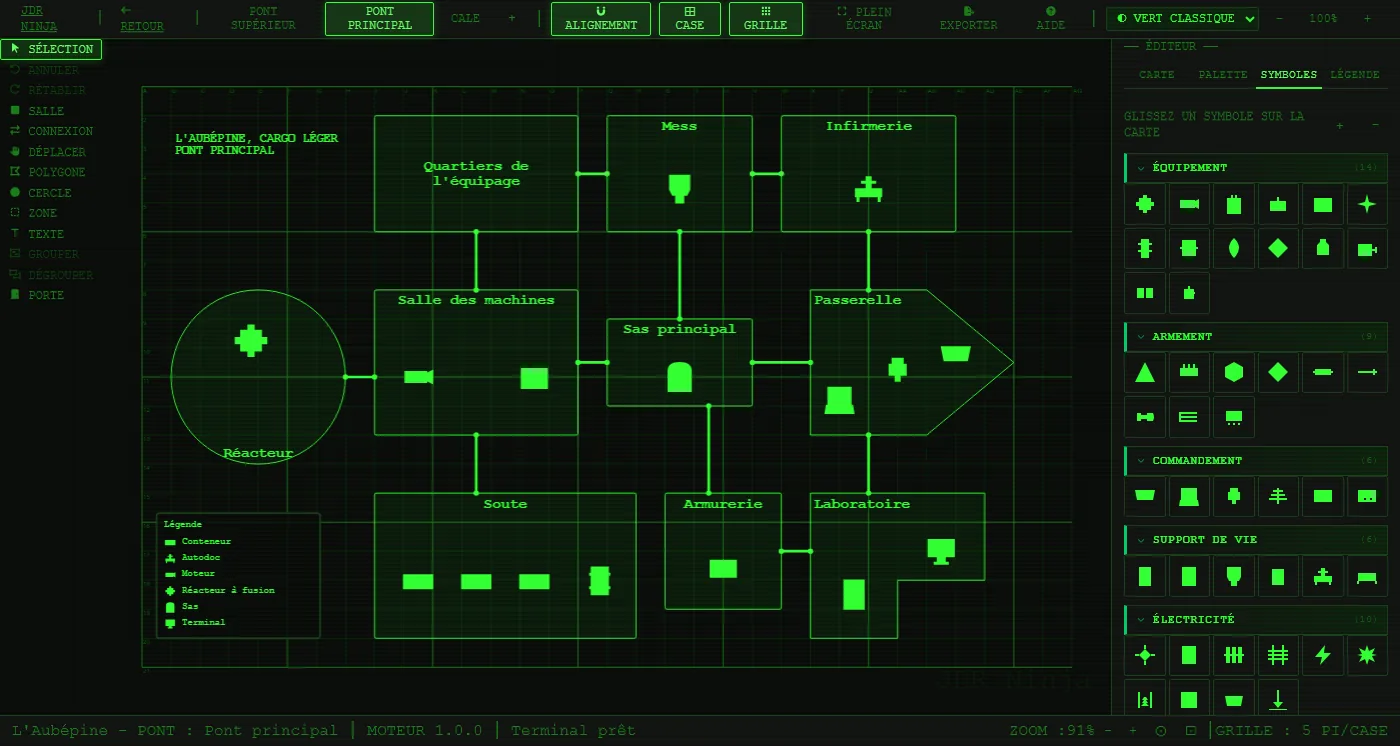
The captures below show the editor on the plan of a light freighter, L'Aubépine: a deck drawn room by room, its three levels with one room's notes, then the export dialog for a virtual tabletop.
Each room is drawn on the grid as a rectangle, a polygon or a circle, then named. Corridors are pulled from one room to the next, and the symbols placed in the rooms say what is there: reactor, consoles, airlock, containers. The drawing tools stay on the left, the symbol library on the right.
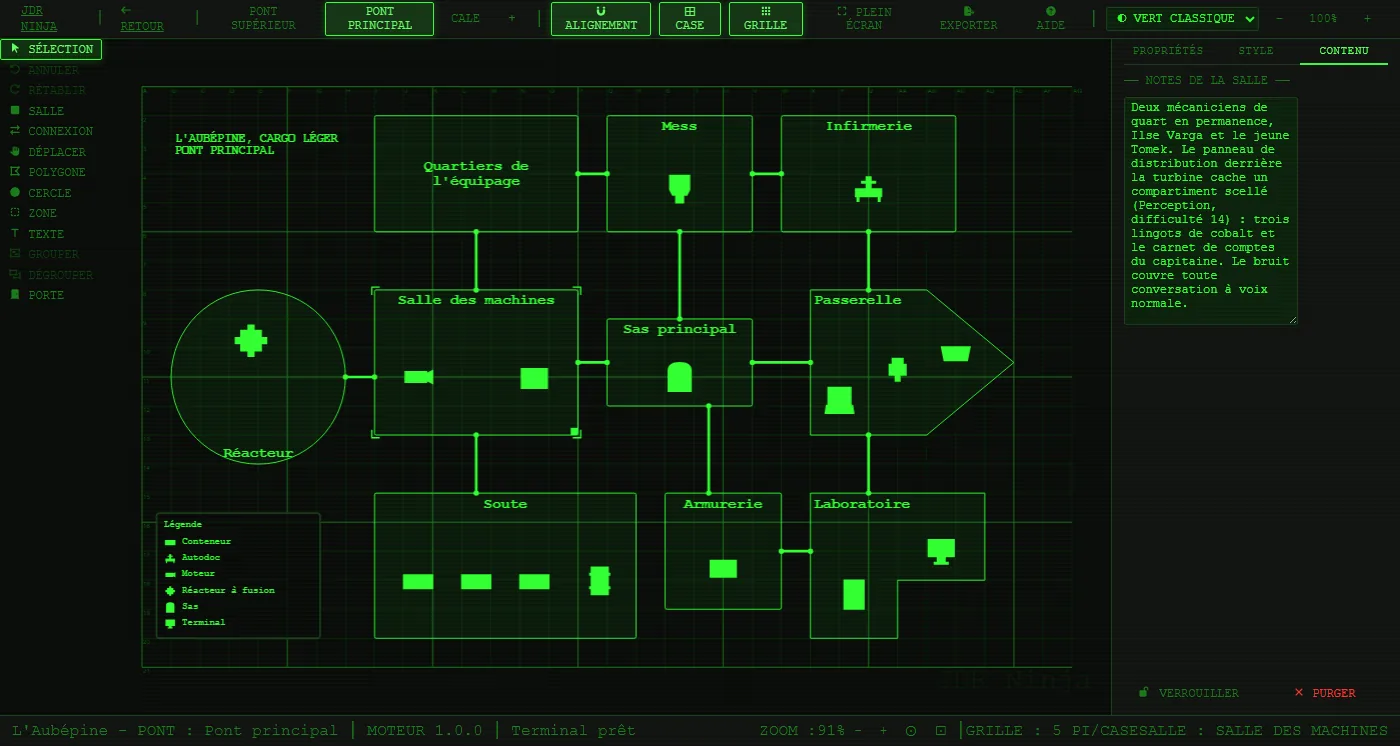
A ship is drawn deck by deck: the tabs at the top of the screen switch between them, each with its own plan. A selected room opens its panel, and the Content tab keeps your GM notes: what the room holds, who is there, what it hides.
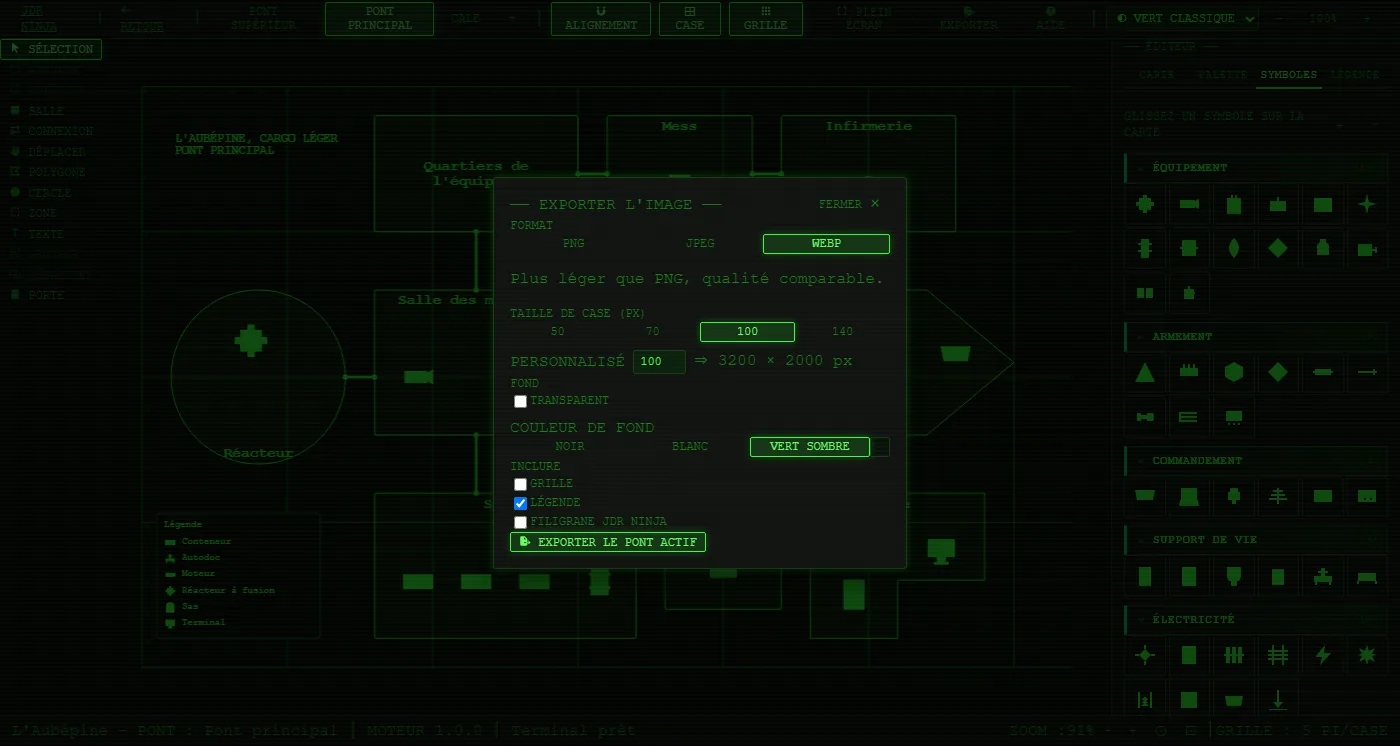
The export dialog picks the image format, PNG, JPEG or WebP, then your table's cell size: 50 for Fantasy Grounds, 70 for Roll20, 100 for Foundry and D&D Beyond, 140 for Owlbear. The image dimensions show before you run the export, with or without the grid and the legend.
The concrete tools you find in the editor, grouped by use.
Rectangles, polygons, circles, zones and free shapes to compose any location.
Link rooms with corridors in a direct, right-angled or curved path.
Everything aligns to the cell; an optional sub-grid places details at a quarter of a cell.
Customisable palette to distinguish zones, sections and room types.
Airlocks, consoles, reactors, weaponry and more: a library of symbols to place on the plan.
One plan per deck or floor, tabs to switch between them.
Description, occupants, secrets: annotate each room freely, for your GM's eyes.
An edit history to step back and experiment without fear.
Cell size suited to Roll20, Foundry, D&D Beyond, Owlbear or Fantasy Grounds.
Choose the image format that suits your workflow.
Your maps stay in your browser, with no account and nothing sent to a server.
Patreon supporters sync their maps across devices.
Start a blank map in seconds, right in the browser. No account required.