Typed relations
"member of", "lives in", "enemy of"… explicit links between entries.
Write your worlds. Run your campaigns. Share them.
Bring your universes to life, keep track of your sessions, and publish them for others to explore.
Atlas is a JDR Ninja module that brings several things together in one place: a workshop where you write your universe (places, factions, characters, events), interactive maps, a timeline, and a campaign space where you track your sessions (arcs, sessions, plot hooks, player characters).
Everything you write is linked. A session can mention an NPC, a plot hook can point to a city, an arc can build on a faction. The editor keeps track of these links and shows them both ways: from the article to the sessions that mention it, from the session to the articles it references.
You can work solo or invite others: each campaign has its own permission system to give your players or a co-GM exactly the rights you want: read, create plot hooks, edit an arc, manage members. You stay in control of what goes public: drafts, secret blocks, upcoming sessions hidden by default.
And when you're ready, you publish. Your world joins the public directory, reads like a wiki, and your campaigns can be followed online: other GMs and players can explore them. Browse the worlds already shared.
A single lore base. Several sessions that build on it without duplicating it. A city written once serves every campaign that passes through it.
Mention an article with @, the editor finds the reference and keeps it indexed. On the NPC's page, you see every session where it appears.
When you publish, your world becomes a wiki anyone can read and your campaigns can be followed online. Other GMs explore, draw inspiration and read their worlds. And you read theirs.
Typed lore articles (place, character, faction, culture, species, item, event, document, rule, note), sorted into categories, linked together. Interactive maps with clickable markers and a timeline to order the world's events.
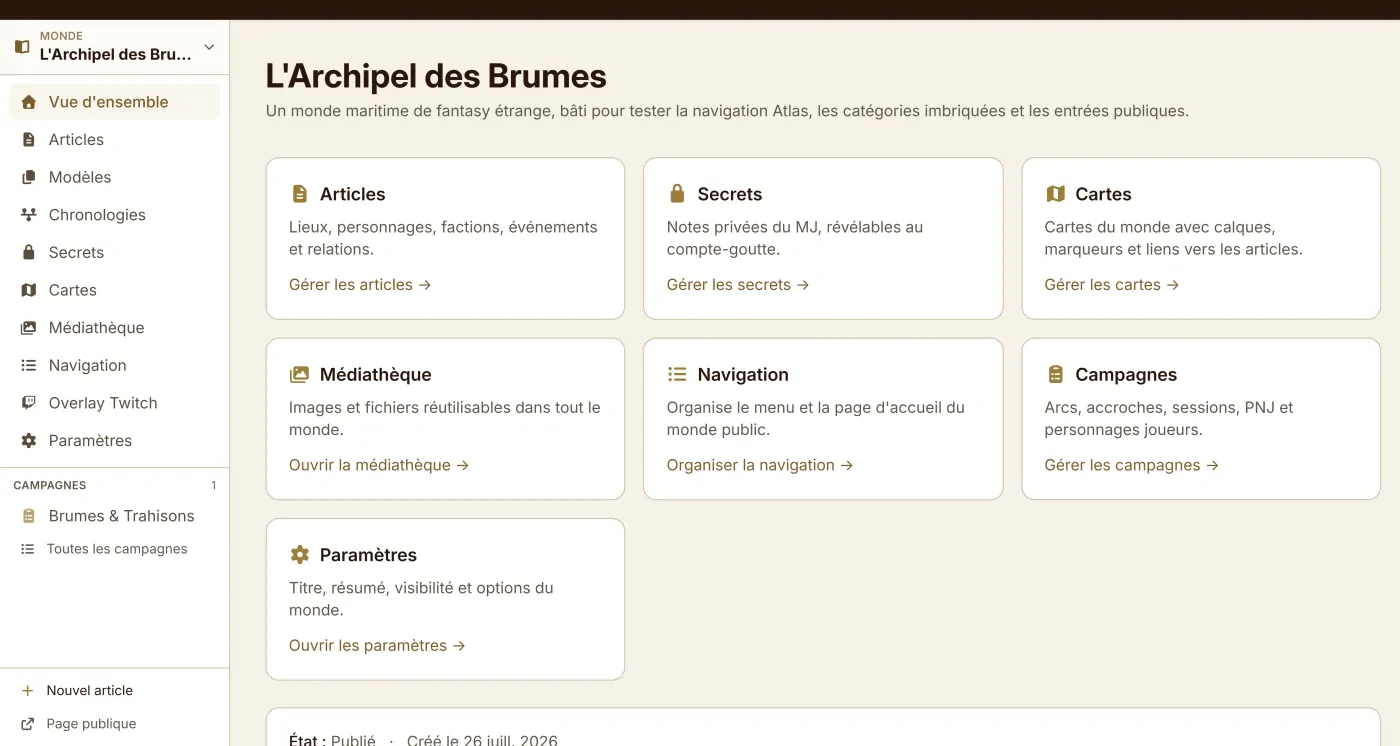
Narrative arcs, dated sessions, plot hooks with their status (to resolve, in progress, resolved, failed), NPCs specific to the campaign, player characters with their session reports. Invited members with fine-grained permissions per arc, hook or NPC.
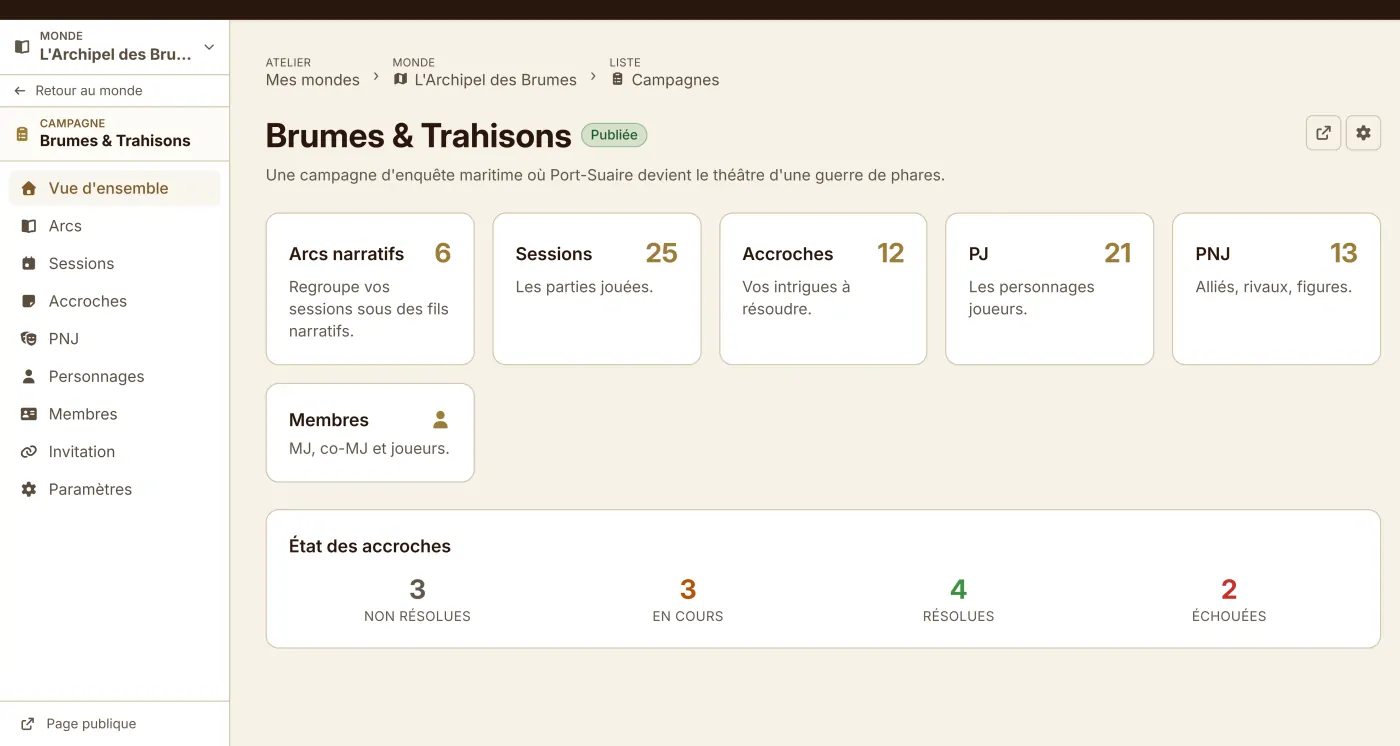
Everything goes through the same editor, with autosave and local recovery in case of an accidental close.
The Atlas Twitch overlay projects a selection of your campaign into an extension your viewers open over the video. Nothing is copied: Atlas stays the source, you choose what goes on air.
A collapsible card over the video, or a panel under the player: the campaign and its current arc, the arcs, the plot hooks with their status, the player characters with their sheet (classes, abilities, skills, senses, languages) and a link to the campaign on JDR Ninja. In French, English, Spanish, German or Italian, with sheets in another language if your table prefers.
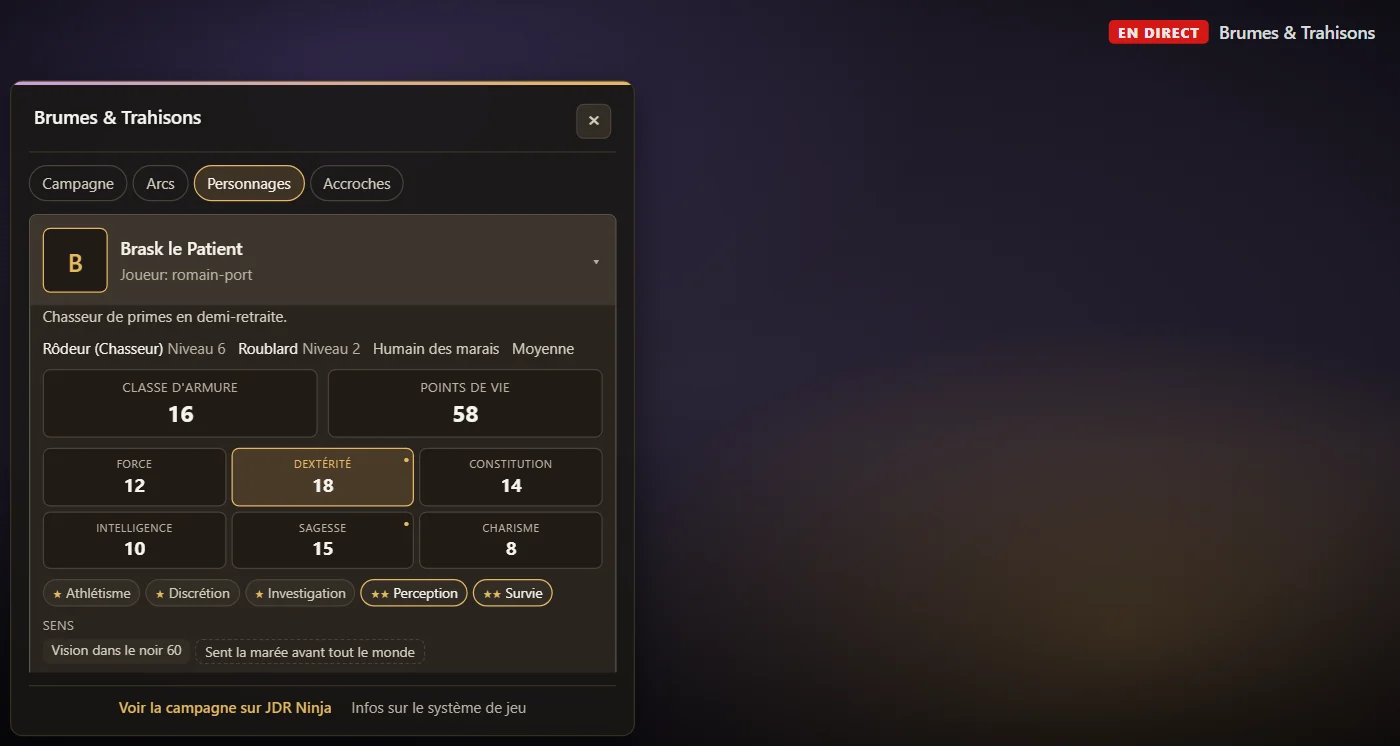
For Atlas subscribers: the overlay from the Gobelin tier, character sheets from the Mimique tier. See the plans.
The concrete tools you'll find in the module, grouped by use.
Several maps per world, clickable markers linked to articles.
Learn moreEvents ordered on a rail, grouped under named era bands.
Learn more"member of", "lives in", "enemy of"… explicit links between entries.
Images organized into folders, reusable across all your entries.
Break your campaign into chapters, date the sessions, keep your notes.
Learn moreTo resolve, in progress, resolved, failed. You see at a glance what's still pending.
A campaign NPC can point to a world entry, or stay specific to your table.
Grant access to a specific arc, plot hook or NPC, not the whole campaign.
Each player has their own dashboard: their characters, upcoming sessions, reports to write.
Learn moreEach player creates and maintains their own sheet: bio, image, notes, traits.
After each session, the player writes their report from their space, at their own pace.
The world's public articles are readable by players, one click away from the campaign.
Type @ to link an article; the target page shows everything that mentions it.
Hide a whole entry or a single block: invisible to the public, visible to you.
Each published entry has its own page; your world reads like a wiki.
Local recovery in case of an accidental close, you never lose your paragraph.
Start from an empty world, or browse the ones other GMs have already published.