Creating an adventure
"Mes aventures" is your starting point. The "Nouvelle aventure" button asks for a title and a short description, then drops you straight into the workshop, on an empty draft.
Nothing is public at this stage, and nothing becomes public until you publish. You may keep as many adventures in progress as your plan allows.

The workshop's four regions
The workshop is a single page, and it never scrolls. On the left, a rail of six buttons picks the mode. Beside it, a panel changes with the mode: the scene list, the library list, the validation report. In the middle, the work surface. On the right, the inspector shows whatever is selected.
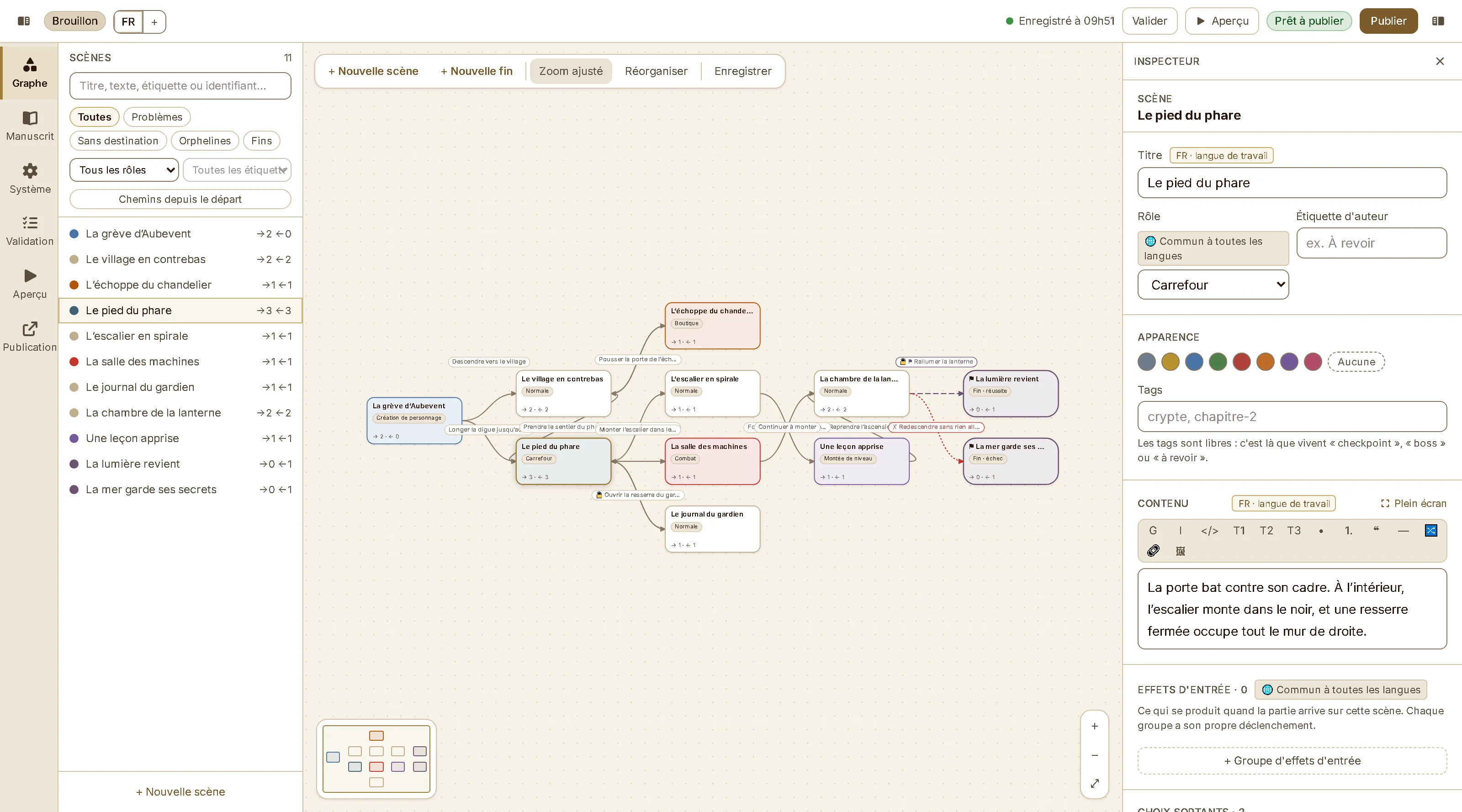
The top bar never changes: it carries the "Brouillon" chip, the working language, the save status, "Valider", "Aperçu" and "Publier".
The overview
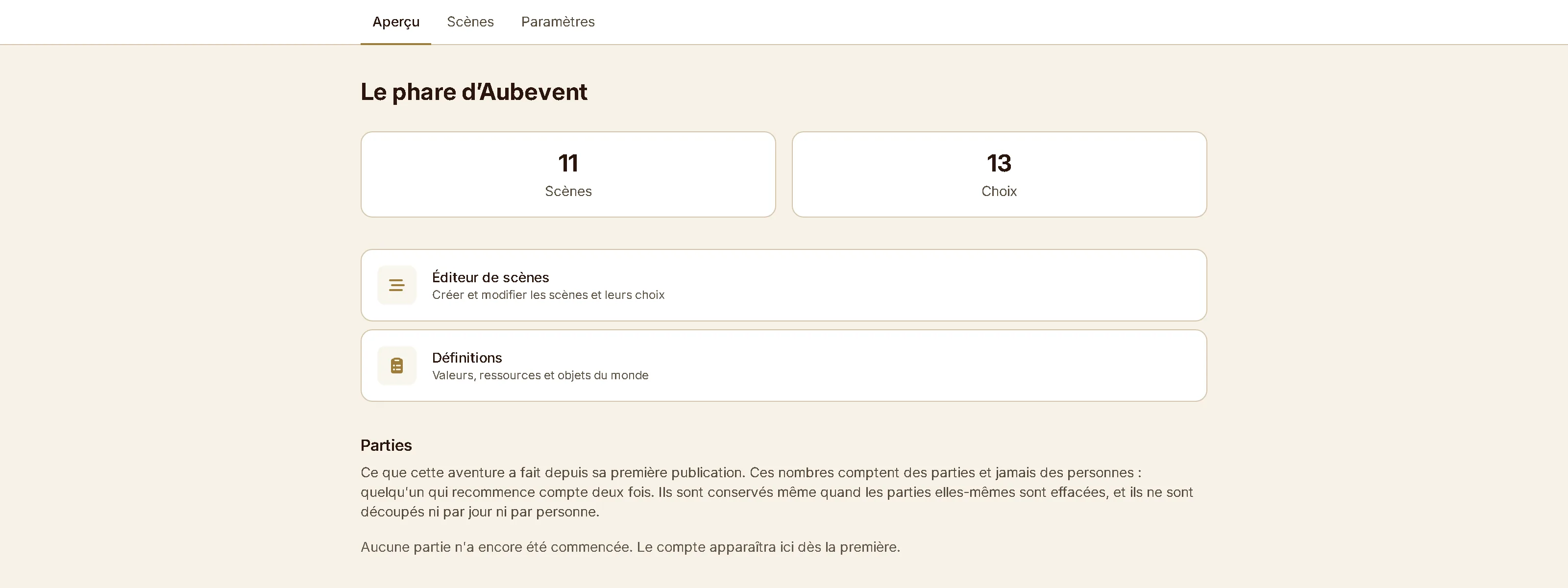
Before the workshop, every adventure has a home page: what the draft holds, what the adventure has done once published, and the three tabs leading to the workshop and the settings.
The six modes
Switching mode reloads nothing and never loses your selection: a scene picked in the graph stays picked in the manuscript.
| Mode | What it is for | Chapter |
|---|---|---|
| Graphe | See the structure: scenes as cards, destinations as arrows. | Scenes and choices |
| Manuscrit | Write straight through: the same scenes as one document. | Scenes and choices |
| Système | Declare: values, items, abilities, shops, combats. | The libraries |
| Validation | Read what blocks, what deserves a look, and where it is. | Checking and publishing |
| Aperçu | Play the draft, and see why a choice is hidden. | Checking and publishing |
| Publication | Put a version online, and look back at the previous ones. | Checking and publishing |
Autosave
There is nothing to save. A second after your last keystroke the workshop sends what changed, and the top bar says so: "Enregistrement…", then "Enregistré à 14 h 32".
If a save fails, the workshop retries on its own, three times, then stops and tells you. It does not retry when the server refused the write: repeating a refused request would only have it refused again.
A desktop screen
The workshop puts three surfaces side by side, and below 1024 pixels wide they stop fitting. The page tells you and still renders, so re-reading a scene from a tablet stays possible; writing does not. Playing an adventure, on the other hand, works on any screen.