A rule is a sentence
A choice's "Règles…" button opens the builder. A rule takes the form of a fill-in-the-blank sentence there: "has the item [Brass key] in quantity at least [1]". The words are fixed, the bracketed slots open a picker or a small number field.
At the top of the panel, a summary rewrites itself on every change and hands the whole rule back as one sentence. It is the same summary that appears in miniature on the graph and in the inspector, which means there is only one way to read a rule anywhere in the editor.
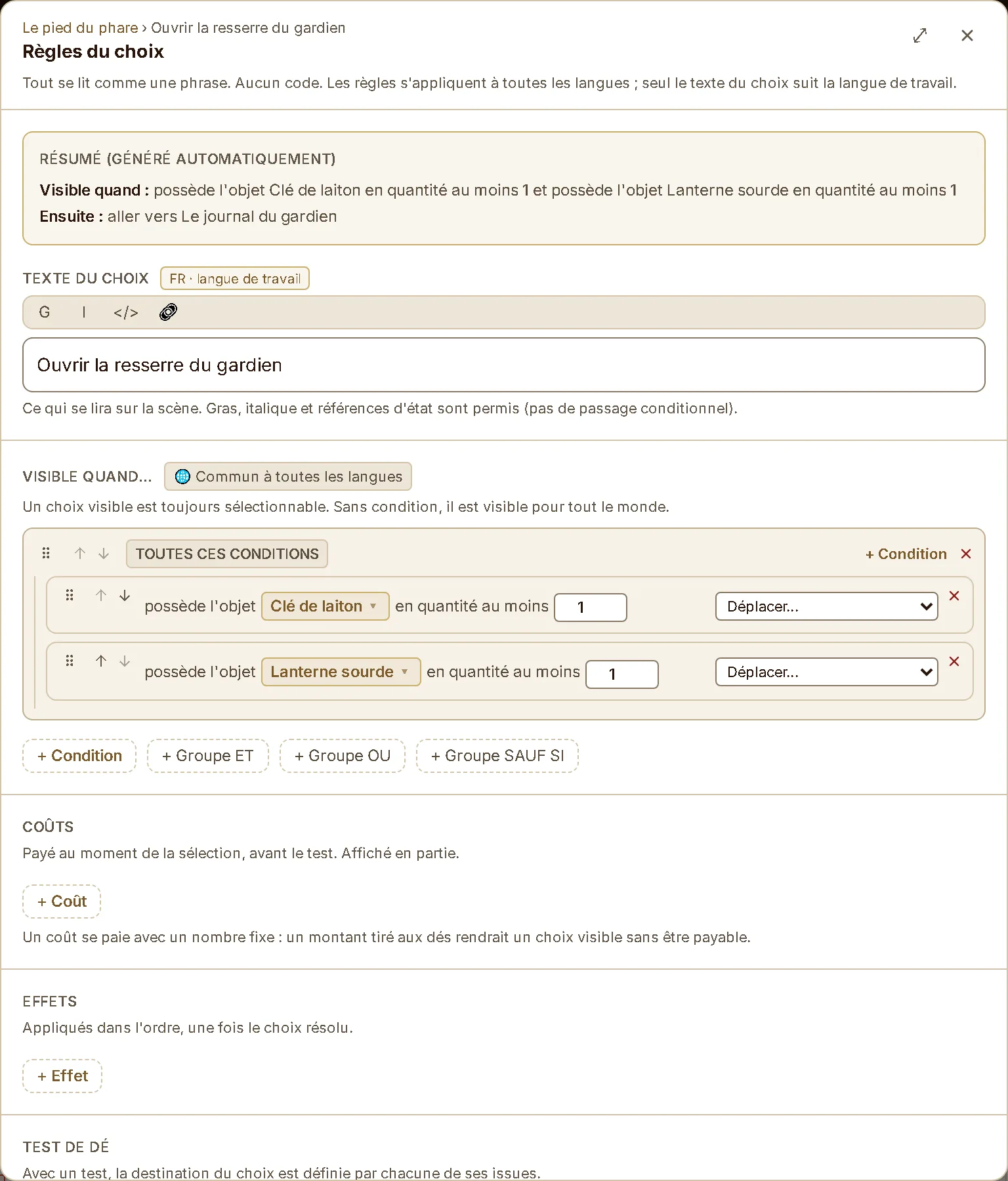
A rule holds for every language at once. Only the choice's text, at the top of the panel, follows the working language.
Picking a condition
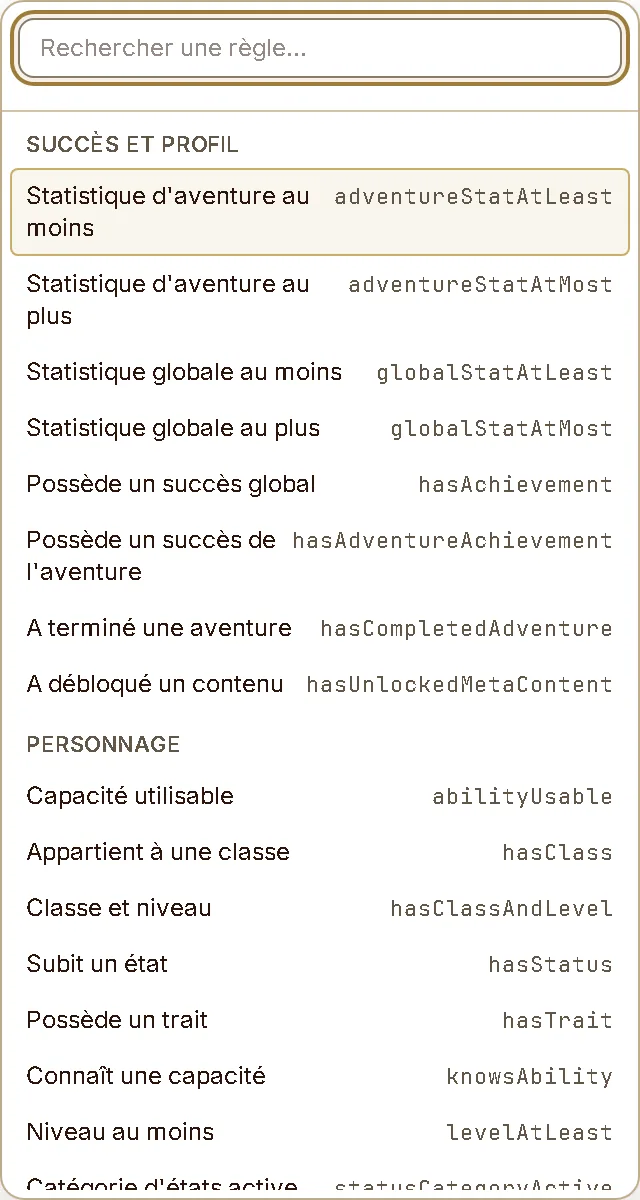
"+ Condition" opens a picker grouped by family: inventory, resources, values, events, character, progression, shop, tests, combat. Each entry reads in plain language there, and the picker offers only what the engine can genuinely evaluate.
A slot left empty shows: the sentence displays a marker in its place, and validation will remind you before publication. It is not an error while you are writing; it is one at publishing time.
Groups
Several conditions placed side by side must all be met. To say something else, you put them in a group, which is a real box on screen with its own label.
| Group | True when | Used for |
|---|---|---|
| ALL OF THESE | Every row it holds is met. | "the key and the lantern" |
| AT LEAST ONE | A single row is enough. | "the key or the lockpicking ability" |
| UNLESS | Its single row is not met. | "unless the bridge is destroyed" |
Costs, effects, tests, destination
Below the conditions, the panel goes down in the order things actually happen to a player.
- Costs are paid the moment the player chooses, before anything else, and they are shown. A cost takes a fixed number: a rolled amount would make a choice visible without being payable.
- Effects apply once the choice resolves, in the order you arrange them. An effect may roll dice.
- A test transforms the choice: the destination leaves it and moves into the outcomes, one per result, each with its own effects.
- The destination closes the panel, and it is the same control as in the inspector: five possibilities, one at a time.
No JSON, anywhere
There is no field in the editor for typing a condition, an effect or a destination by hand. No advanced mode, no source view, no temporary escape hatch. A "Détails techniques" disclosure shows a rule's compiled form, read only, for those who are curious.
The consequence is simple: until a rule is in the picker, it cannot be written. That is a constraint, and it is also what guarantees that a saved rule will be understood by the engine the day somebody plays it.