The graph
Each scene is a card, each destination an arrow. A card's colour and shape state its role: start, hub, shop, combat, character creation, level up, ending. An ending has a distinct, rounder shape, and keeps it even if you repaint it.
Arrows read too: a solid line leads to another scene, a long dash completes the adventure, a short red dash fails it. A padlock on a label marks a choice that is not always visible.
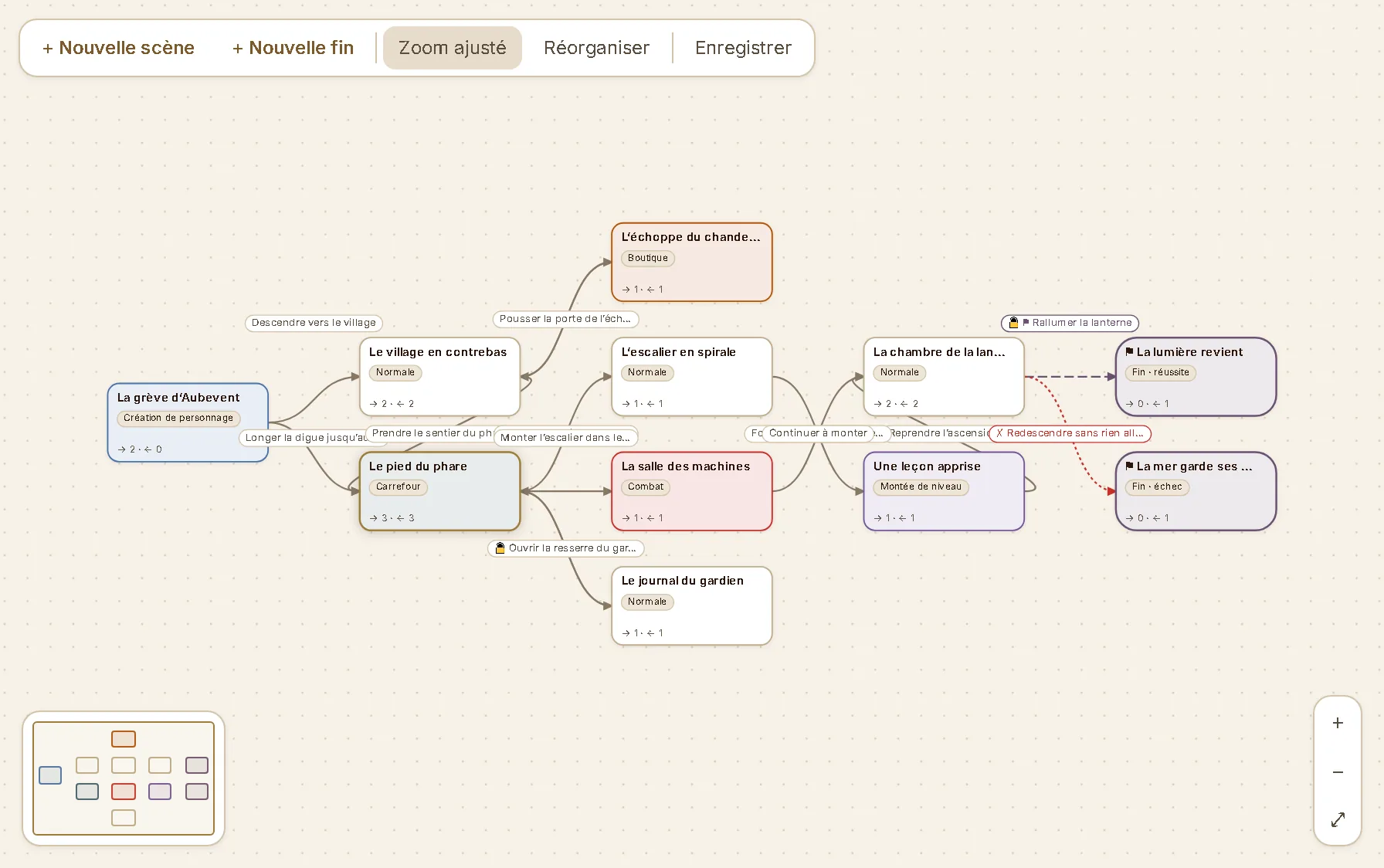
"Réorganiser" re-lays the whole graph out and overwrites your placements; "Zoom ajusté" merely fits everything on screen. A card you move stays where you put it, and nothing moves it afterwards.
The scene list
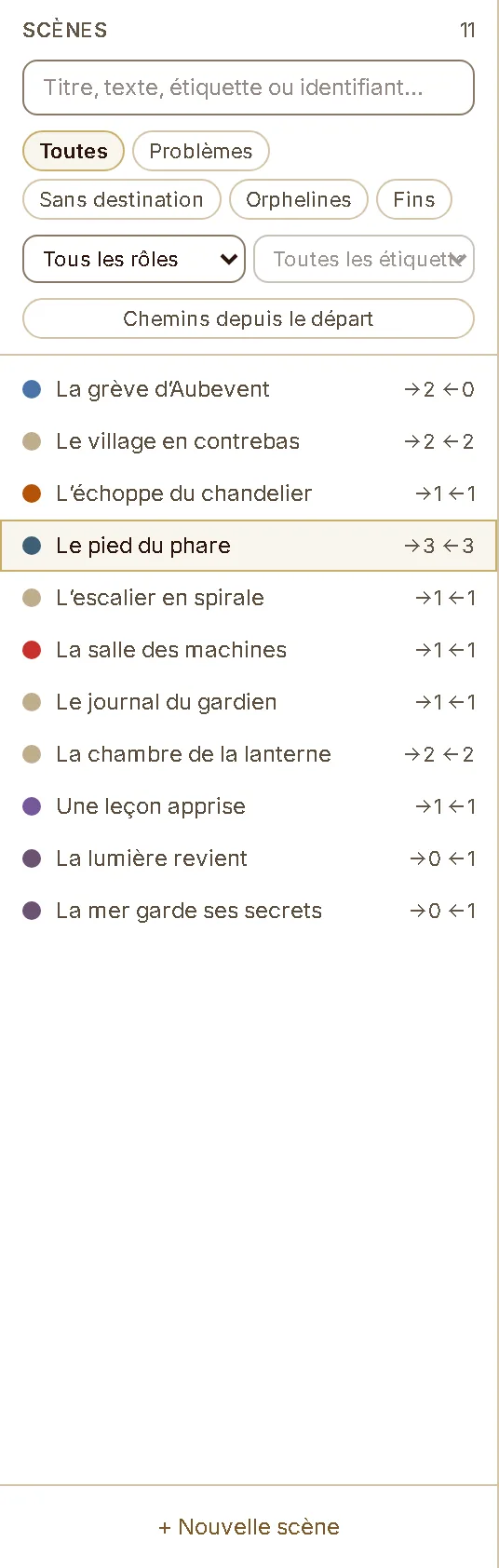
The left panel lists the scenes and mostly serves to find your way once there are many. The search covers the title, the text and the tags; the chips above keep only the scenes with a problem, those with no destination, those nobody reaches, or the endings.
What the canvas does not do
The graph is a view, not a link editor. These five absences are deliberate, and the first is the one everybody tries first.
- You cannot drag an arrow from one card to another. A destination belongs to a choice, and is set in the inspector. Dropping a card on another creates nothing.
- You do not write on a card. It shows a title; the text is written in the inspector or in the manuscript.
- Only one thing is selected at a time. A card, or an arrow.
- Nothing rearranges behind your back. Only a drag, an arrow key or "Réorganiser" moves a card.
- The canvas takes no annotations. No sticky notes, no coloured areas. To mark a scene, use its author label or its tags.
The inspector: a scene
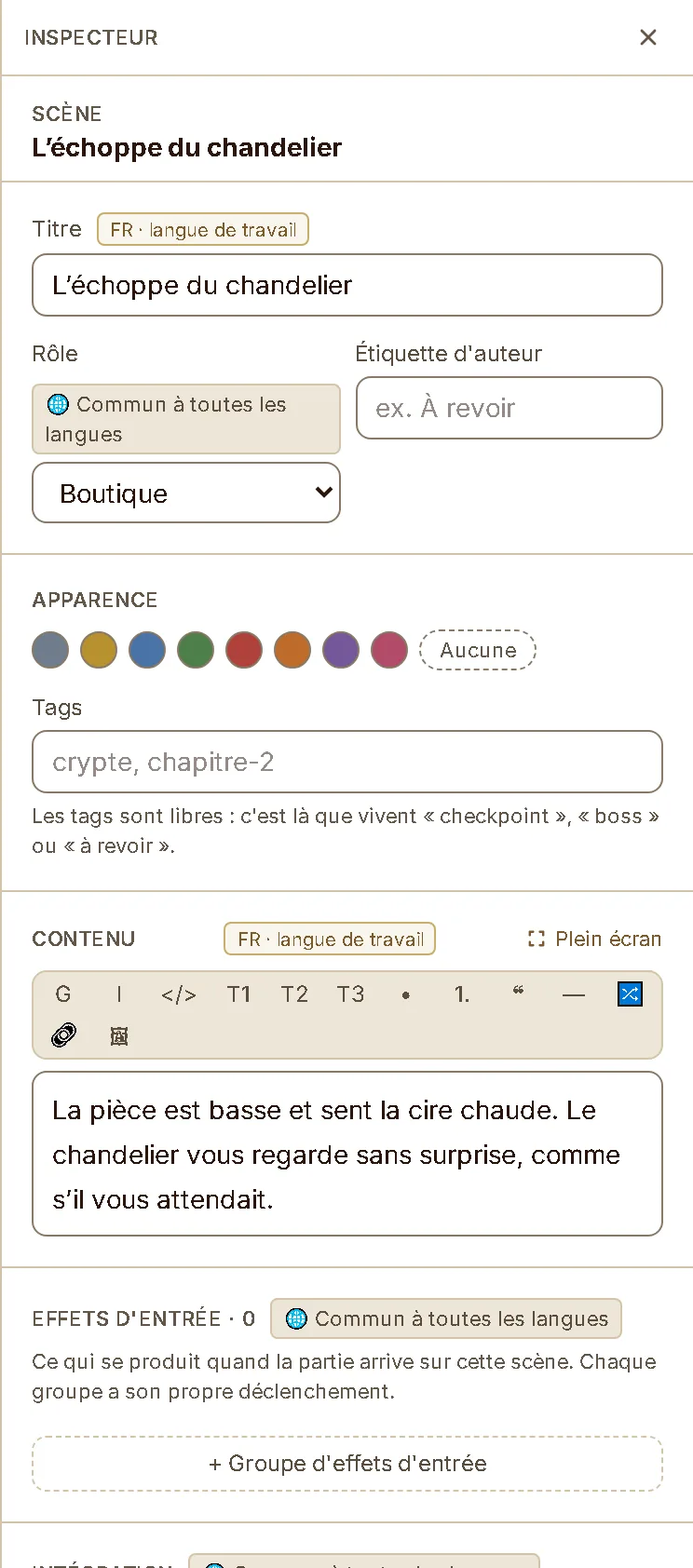
Clicking a card opens its form on the right: title, role, appearance, tags, text, entry effects and the list of choices leaving it. The role is the only field that changes what the engine does; the rest is organisation.
"+ Ajouter un choix" creates an empty choice, with no destination. That is a normal working state: it will only appear on the graph once it leads somewhere.
A choice, and its destination
A choice carries a text, possibly some rules, and exactly one destination. There are five possibilities, not one more.
| Destination | What happens | What it asks for |
|---|---|---|
| No destination yet | The choice exists but leads nowhere. It does not show on the graph. | Nothing. It is the state of a choice being written. |
| Go to a scene | The player moves to the named scene. This is the common case. | A scene. Endings are not offered here. |
| Complete the adventure | The run ends on the chosen ending, and that ending is added to the endings the player has discovered. | An ending of the success kind. |
| Failure | The run stops on a failure. You write the reason the player will read. | A reason, required. A failure ending, optional. |
| Stay on the scene | The effects apply and the player re-reads the same scene. Handy for searching a place. | Nothing. Watch out for loops with no way out. |
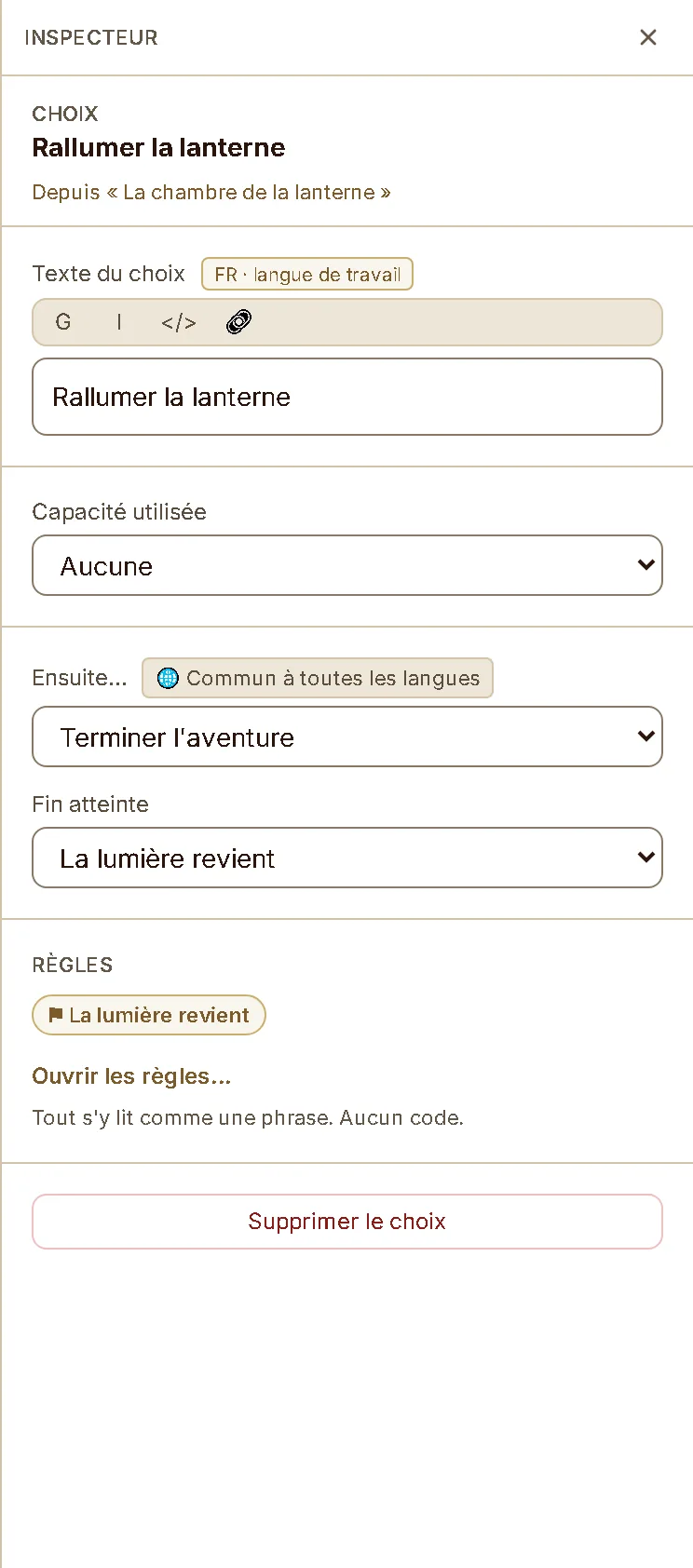
If the choice carries a dice test, the destination leaves the choice and moves into the outcomes: one per result. That is what makes it impossible to write a test with nowhere to go.
The manuscript
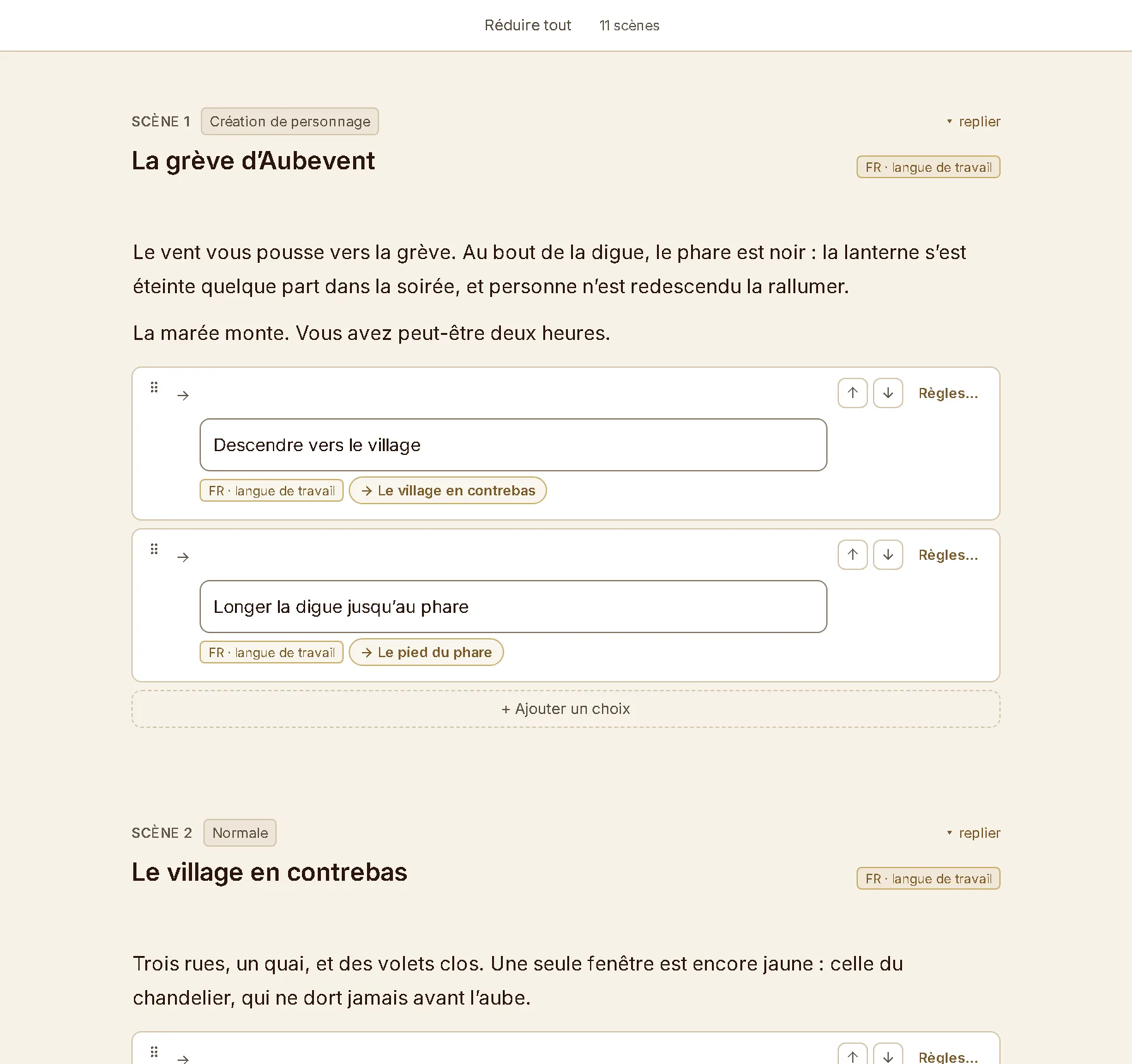
The manuscript shows the same scenes one after another, like a document. It is where you write at length: a scene's text, its choices, then the next scene, without changing screens. Between two scenes, a dashed button inserts a new one at that exact place.