The text editor
The same component serves a scene's text, an ending's text, a choice's label and the definitions' descriptions. Its toolbar changes with the place: full inside a scene, cut down to bold and italic on a choice label, which is a single line.
There is no source mode, no Markdown, no HTML view. A paste from elsewhere is re-read and reduced to what the editor can represent; what it cannot represent is dropped rather than smuggled through.
Three blocks that are not text
Three tools in the bar insert something other than words. Each is a whole block: you select and delete it in one go, you do not edit it letter by letter.
- The conditional passage is a paragraph the player reads only when a condition is met. Its header states the condition in words, and opening it gives the same builder the choices use. A "+ Sinon…" adds the version everybody else reads.
- The reference drops a piece of state into the sentence: the character's name, the number of coins in pocket. It appears as a pill and fills in at reading time.
- The image is picked from the adventure's image library. There is no caption, no cropping and no alternative text: carry what the picture shows in the prose, for a reader who does not see it.
The working language
An adventure is written one language at a time. The selector in the top bar says which, and its "+" button adds a new one. The whole workshop then switches: the titles, the texts and the labels you see are that language's.
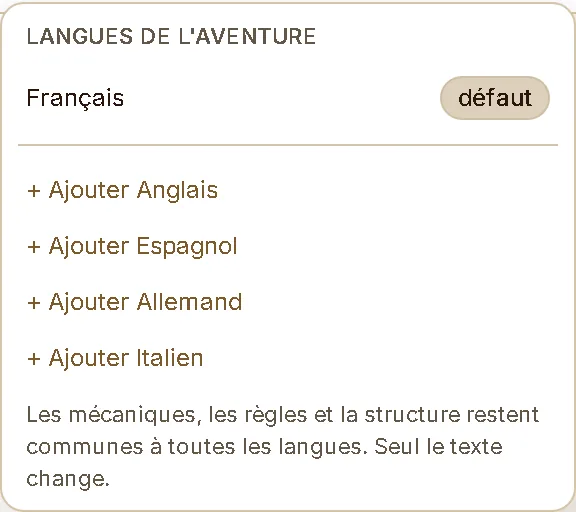
This selector has nothing to do with the site's language. You can read the workshop in French and write an adventure in English there; the two settings are independent.
Translating
In a language other than the original one, a not-yet-translated text shows greyed out and read only, with the source inside it and a "Traduire" button. That opens an empty field, never a copy: the source stays visible beside it, so that you translate rather than tweak.
The manuscript panel then adds gap navigation: "Aller au suivant non traduit", and the list of what is still missing. Each row opens the scene or the definition that holds the field.
What is shared across languages
This is the distinction that saves the most time: translating is not duplicating. The surfaces concerned carry a small "🌐 Commun à toutes les langues" marker as a reminder.
- The structure. Scenes, their roles, choices and their destinations, the manuscript order, the cards' positions on the graph. Adding a scene adds it in every language.
- Rules and numbers. Conditions, costs, effects, tests, formulas, starting values, prices. A rule fixed is fixed everywhere.
- Images. One library for the whole adventure, with no language dimension. That is why what the picture shows must also be in the text.